A 2-kilogram DIY drone reaching 730 km/h is not just a record clip; it is evidence that small, custom-built UAVs can now enter performance bands that strain the usual mental model for hobbyist aircraft. Benjamin Biggs of Drone Pro Hub has pushed his Black Bird drone to a reported 730 km/h (453.6 mph) downwind peak, with a 685 km/h (425.6 mph) average top speed, according to Notebookcheck.
The headline is speed. The more interesting story is iteration. Biggs had already taken back the world’s fastest RC battery-powered drone record in January, after trading records with “the Bells,” and this latest run extends that lead before they have answered. MLXIO analysis: that makes Black Bird less a one-off stunt than a live engineering race, where propeller geometry, materials, power delivery, and flight stability are being tuned in public.
Black Bird’s 730 km/h run turns a tiny airframe into a stress test
The latest Black Bird version reportedly weighed 2 kilograms, or about 4.4 pounds, and hit 730 km/h (453.6 mph) with the wind behind it. Its upwind pass reached 640 km/h (397.7 mph), producing the cited 685 km/h (425.6 mph) average top speed. Those numbers matter because the craft is not a large aircraft with generous structural margins. It is a compact, battery-powered drone being pushed into a narrow performance window.
The key record data: 730 km/h (453.6 mph) downwind, 640 km/h (397.7 mph) upwind, and 685 km/h (425.6 mph) average top speed.
At those speeds, the headline risk is not only whether the motors can spin hard enough. Drag rises brutally with speed. Vibration can destroy control authority. Heat builds in batteries, wiring, motors, and electronics. Small errors in geometry or balance become expensive fast.
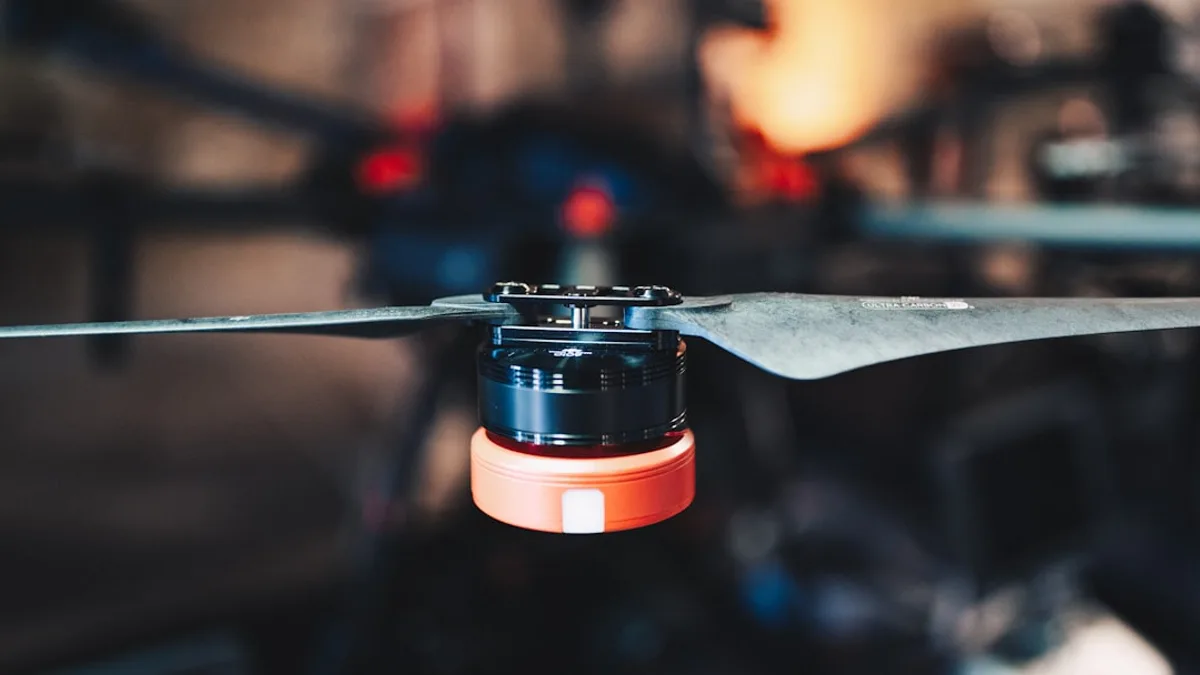
Biggs’ reported changes were specific. He increased the propeller pitch, switched to carbon fiber propellers, and added a toothed propeller design that he says helps air flow straight past rather than wrap around the propellers in spin-wise directions. That is the core lesson: at the edge, small aerodynamic changes can produce large results, but they also narrow the safe operating band.
| Black Bird run metric | Reported figure |
|---|---|
| Drone weight | 2 kg / 4.4 lb |
| Downwind peak | 730 km/h / 453.6 mph |
| Upwind run | 640 km/h / 397.7 mph |
| Average top speed | 685 km/h / 425.6 mph |
| Peak power draw | 19.1 kW / 25.6 horsepower |
| Current and voltage | 449 A at 42.5 V |
The counterpoint is important. A top-speed drone is not automatically a useful drone. The source does not report payload, endurance, range, low-speed handling, or repeatable recovery performance. One drone was lost after video feedback failed. Another crash-landed after Biggs kept it at full throttle longer because of windy weather, with the batteries dying and smoking afterward.
The record race is becoming iterative, not accidental
Biggs and “the Bells” have been trading speed records for a while, according to the source material. Since Biggs took back the crown in January, the Bells have not posted a response, though they reportedly admitted they are working on one. That back-and-forth matters because it changes the nature of the achievement. This is no longer only a talented builder finding a lucky configuration. It is a competitive loop.
The pattern resembles other hardware races MLXIO tracks, where one hard metric becomes the story and forces sharper scrutiny of what the number really means. That showed up in our coverage of the 78% Speed Claim Turns Boox Note X6 Into a Tablet Threat, and in a different consumer-hardware context with OnePlus Nord 6 Exposes Android's Flagship Speed Tax. Black Bird is more extreme, but the media dynamic is similar: one number dominates, then the engineering caveats decide how much the claim is worth.
MLXIO analysis: the strongest reading is that Biggs is exposing how fast the DIY development cycle can move when builders can revise designs, test quickly, and publish results. The strongest counterpoint is that speed records reward specialized setups. A drone optimized for peak velocity may be poor at everything else. But the thesis still holds because the latest Black Bird did not improve through mystery. It improved through named changes: propeller pitch, carbon fiber construction, and blade-edge geometry.
The power draw explains both the breakthrough and the fragility
The most revealing number may be 19.1 kW. Notebookcheck reports that during the runs, the drone reached a peak draw of 19.1 kW (25.6 horsepower) at 449 A and 42.5 V. For a 2-kilogram aircraft, that is an aggressive power-to-weight setup. It also explains why the record attempt produced smoke after a crash landing.
High current is unforgiving. It punishes connectors, cells, thermal paths, and wiring. It also reduces the margin for error when a pilot has to keep pushing in imperfect conditions. The source says windy weather led Biggs to hold full throttle longer, after which the batteries died out and smoked after the drone came down.
That sequence is the useful part for anyone following DIY drone engineering. The record was not just a triumph of more power. It was a demonstration of how quickly power becomes a reliability problem when the aircraft is small and the operating envelope is extreme.
MLXIO analysis: this is where the Black Bird story becomes more serious than a speed brag. If future builders want records that stand up to scrutiny, they will need more than higher peak output. They will need better thermal control, cleaner video and telemetry resilience, stronger recovery planning, and repeatable bidirectional runs under clearer conditions.
Builders, regulators, and security teams would not see the same aircraft
For the engineering community, Black Bird validates disciplined experimentation. Biggs changed specific parts, tested, lost hardware, then produced a faster second run. That is a familiar maker pattern, just at an unusually violent speed.
For aviation authorities, public-safety teams, insurers, and defense analysts, the same facts would raise different questions. MLXIO analysis, not a reported reaction: a 4.4-pound aircraft near 454 mph sharpens concerns around detectability, collision energy, remote identification, and enforcement if similar performance leaves controlled test settings. The source does not report any regulator response, policy review, insurance reaction, or defense assessment. Those remain open questions.
Commercial implications are also limited by what is not in the source. There is no evidence here that Black Bird’s configuration is ready for inspection, mapping, logistics, emergency response, or any other practical deployment. The value is upstream. Builders and UAV companies can learn from the materials, propulsion choices, and failure modes, even if the record aircraft itself is too specialized for normal operations.
The next benchmark is not just higher mph
Biggs now plans to break the official Guinness World Record with the new drone, according to the source. That gives the story a clear next test: whether Black Bird’s latest reported performance can translate into an official record environment with acceptable validation, bidirectional evidence, and controlled conditions.
The evidence that would strengthen the thesis is straightforward:
- Repeatability: multiple high-speed runs without losing video feedback or smoking batteries.
- Verification: independent timing or recognized record validation.
- Control: stable passes in less favorable wind conditions.
- Survivability: recovery without crash-landings after full-power runs.
The evidence that would weaken it is just as clear. If future attempts only produce isolated downwind peaks, repeated losses, or battery failures, Black Bird remains a spectacular specialized machine rather than a signal about broader compact UAV capability.
For now, the record’s meaning sits between those poles. 730 km/h proves that a tiny battery-powered drone can be pushed far beyond ordinary expectations. The next race will show whether that speed can be controlled, repeated, and certified — or whether the edge of DIY drone performance is still defined by how much hardware a builder is willing to lose.
Impact Analysis
- A 2-kilogram DIY drone reaching 730 km/h shows hobbyist UAVs are entering extreme performance territory.
- The record highlights rapid public iteration in propellers, materials, power delivery, and flight stability.
- At these speeds, small drones face serious engineering limits around drag, vibration, heat, and control.