If a 2kWh power station can quietly drain itself before the outage starts, how much backup power did the buyer really buy?
That is the sharper question behind Anker’s Solix S2000, a new mid-range power station that attacks two problems most spec sheets bury: idle AC power draw and physical bulk. The unit is launching at $599 for preorders before June 1st, which works out to $0.29 per Wh, according to The Verge.
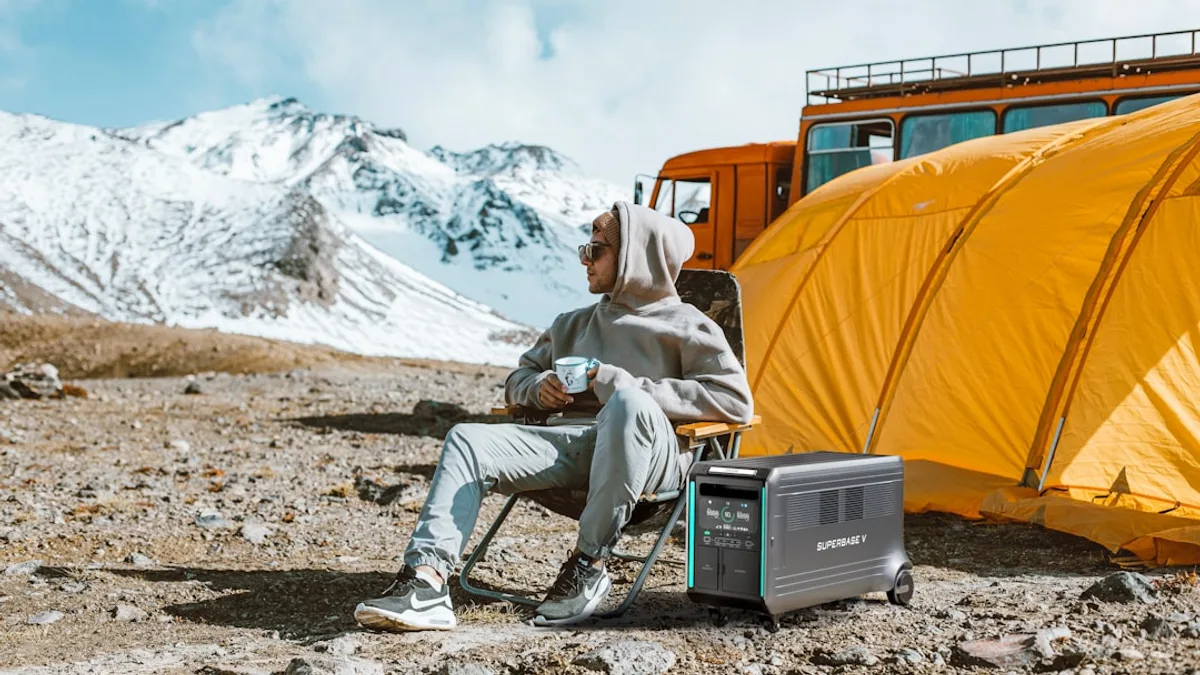
Anker is not just selling another battery box. It is trying to make the 2kWh class feel less fragile in real use: small enough for vans and tight storage, but credible enough for home backup when a fridge, CPAP machine, networking gear, or basic appliances need to stay running.
If the battery is full on paper but empty in practice, what did Anker actually fix?
The Solix S2000 targets a deceptively expensive failure mode: leaving the AC output on. In many power stations, the inverter keeps drawing power even when nothing meaningful is plugged in. That phantom load can turn a supposedly ready backup battery into dead weight after a few days.
Anker says the S2000 draws about 6W when idle. The Verge contrasts that with competing 2kWh-class units from EcoFlow, Bluetti, and Jackery, whose inverters can produce over 2400W of AC power but whose idle draw can exceed 30W.
“That compares to almost two weeks for the Anker Solix S2000, but only if the 6W figure is to be believed.”
That caveat matters. The thesis here depends on real-world confirmation. If the 6W figure holds, Anker has not merely improved efficiency; it has changed the trust model. A backup battery is only useful if it is still charged when the lights go out.
The second fix is size. At 208 x 282 x 323mm, the S2000 reaches about 106Wh/L, which The Verge says beats larger 2kWh power stations such as the EcoFlow Delta 2 Max, Bluetti AC200L, and Jackery 2000 Plus. That matters because backup power often fails the household test before it fails the electrical one: where do you put it?
Does $0.29 per Wh make the S2000 a price weapon or just a launch coupon?
The $599 preorder price is the loudest number in the launch. At $0.29 per Wh, the S2000 is priced aggressively for a power station in the 2kWh range. That framing pushes buyers to compare the product less like a gadget and more like stored energy with ports attached.
But the deal has an expiration date. The Verge reports that after the preorder window, the price will rise to somewhere between $679.99 and $1,199.99. That is a wide band, and it blurs the signal. At $599, the S2000 looks like a challenge to the category. At the upper end of that range, buyers will scrutinize every compromise.
The pricing also raises a harder question for Anker’s rivals: if a smaller 2kWh-class unit can launch at this price while claiming lower standby losses, how much premium can competitors defend on inverter output alone?
| Product / group | Capacity class | AC inverter detail | Idle draw detail | Size / density detail |
|---|---|---|---|---|
| Anker Solix S2000 | 2kWh | 1500W, peak up to 3000W | About 6W, per Anker | 208 x 282 x 323mm, about 106Wh/L |
| EcoFlow, Bluetti, Jackery competitors cited by The Verge | 2kWh range | Tend to use over 2400W inverters | Can exceed 30W | Described as larger 2kWh power stations |
MLXIO analysis: the launch price alone does not prove margin pressure or component commoditization. The source does not provide Anker’s costs, warranty terms, expansion options, or charge-speed data. But the price does sharpen the buying decision: users can now ask why they should pay more for a bulkier box that may burn more energy while waiting.
For adjacent context on how price pressure shows up across charging hardware, see MLXIO’s coverage of Ugreen’s $18 X740 Charger undercutting Anker’s $40 bet.
Is a 6W idle draw more important than a bigger inverter?
For some buyers, yes. That is the most interesting trade-off in the S2000.
Anker chose a 1500W inverter, while The Verge notes that competing 2kWh systems often use inverters over 2400W. On paper, that makes the S2000 look less muscular. In practice, The Verge says 1500W is enough to run most household appliances and networking gear, plus common camper devices including a coffee maker, water boiler, and small induction cooktop.
The S2000 can also peak temporarily at up to 3000W, which The Verge says can cover some high-draw devices such as hair dryers. Its 2kWh battery capacity is described as enough to keep a large fridge / freezer combo running for more than a day during an outage.
That makes the design logic clear. Anker appears to be betting that many users would rather have lower standby losses than a larger inverter they rarely use. A power station that survives almost two weeks with AC left on, if verified, could be more useful than one that can support a bigger momentary load but drains itself in a few days.
The unknown is whether the idle efficiency holds across ordinary use patterns. The supplied source gives Anker’s AC idle figure, but not a full matrix across every port and mode. Buyers should treat the 6W claim as the number to test, not the number to assume.
Can a 2kWh box this small serve both a fridge and a van?
The S2000 is clearly aimed at overlapping use cases that usually pull product design in different directions.
For vanlifers, the value is compactness. A 35.7 pound (16.2kg) power station is not ultralight, but the smaller footprint makes it easier to place in a vehicle where every liter competes with storage, tools, water, or gear. The front-and-back AC layout also matters: the S2000 has three AC jacks on the front and two on the back, reducing the need to reposition the unit.
For home backup, the key promise is readiness. A large fridge / freezer combo running for more than a day is the kind of concrete use case that turns watt-hours into an actual household outcome. Low idle draw strengthens that case because emergency batteries often sit unused until they suddenly matter.
For job sites, the source supports a narrower reading. The Verge names job sites as one of the target environments, and the 1500W continuous output plus 3000W temporary peak gives the S2000 a plausible role for some AC tools or support gear. But the supplied material does not specify ruggedness, dust protection, runtime under tool loads, or cooling behavior.
The ports are practical, not exotic: two USB-C jacks at up to 100W, one USB-A, and a 400W solar panel input. That solar input gives off-grid users a way to refill the pack, though the source does not state full recharge times.
For another compact-hardware trade-off where size, heat, and power collide, MLXIO’s analysis of Acemagic’s G3A and its 3.46L desktop design is a useful comparison point.
Does this prove portable backup power is maturing, or only that specs are getting sharper?
It proves less than the marketing will want, but more than a normal product launch.
The S2000’s significance is not that it has 2kWh of capacity. The market already has products in that class. The more important move is that Anker is competing on hidden usability metrics: standby consumption, density, port placement, and price per watt-hour.
That is a healthier contest for buyers. Peak wattage is easy to advertise. Usable energy over time is harder. A battery that quietly wastes power in standby forces users to babysit it, recharge it more often, or discover the problem during an outage. Anker’s OptiSave branding — the company’s name for the efficiency technology behind the lower idle draw — puts that issue directly into the sales pitch.
Still, the source does not establish a broader historical shift from gas generators or a market-wide move toward any specific battery chemistry for this product. The careful conclusion is narrower: within the 2kWh portable power station category, Anker is making efficiency and size part of the headline fight.
Which evidence would make the S2000 hard for rivals to ignore?
The strongest confirmation would be independent testing that shows the Solix S2000 stays near Anker’s 6W idle claim with AC enabled over multiple days. The second proof point would be sustained appliance performance: fridge backup, networking gear, camper loads, and temporary high-draw devices behaving as The Verge’s spec read suggests.
Evidence that would weaken the thesis is just as clear:
- Idle drain: Real-world standby draw lands much higher than Anker’s claim.
- Thermals: The smaller enclosure forces louder cooling or throttling under common loads.
- Pricing: The $599 launch deal disappears and typical pricing moves close to $1,199.99.
- Usability gaps: Charging speed, expansion options, or warranty terms disappoint once fully disclosed.
If Anker’s claims survive testing, the S2000 could reset expectations for the mid-range power station buyer: not just “How many watt-hours?” but “How many are still there when I need them?” That is the question competitors with larger boxes and higher idle draw will have to answer next.
Key Takeaways
- Lower idle draw could make backup batteries more reliable during outages.
- A smaller 2kWh design makes portable power more practical for vans, homes, and tight storage.
- At $599, the S2000 pushes price and usability improvements into the mid-range power station market.