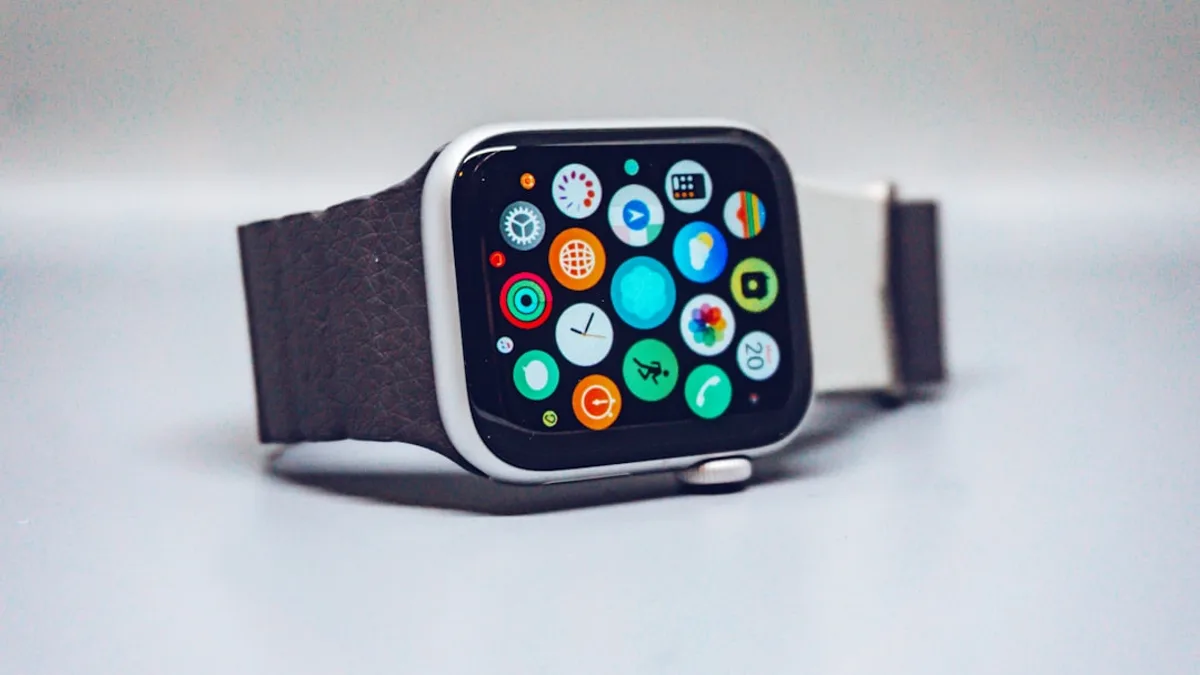
Roughly nine out of every ten Edge AI-capable smartwatches shipped in Q1 2026 were Apple Watches. That is the real signal inside Counterpoint Research’s latest wearable data: Edge AI smartwatches are growing fast, but the category is not yet broad-based. It is overwhelmingly an Apple Watch story.
According to 9to5Mac , global Edge AI-capable smartwatch shipments grew 70% year over year in Q1 2026, reached 25% market penetration, and Apple accounted for roughly 90% of those shipments.
Apple Watch turned a 70% growth category into a one-company market
The headline number says Edge AI wearables are breaking out. The ownership number says something sharper: Apple is defining the category before most rivals have a meaningful seat at the table.
The supplied material describes Edge AI more generally: AI and machine learning tasks run locally on the device instead of relying entirely on cloud servers. In smartwatch terms, that makes local processing for health, safety, or interaction features the meaningful dividing line, rather than vague AI branding.
That framing puts the focus on whether real features can process inference locally, supported by hardware such as Apple’s Neural Engine or another NPU.
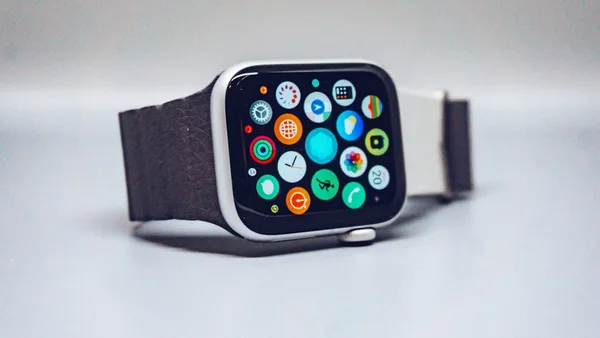
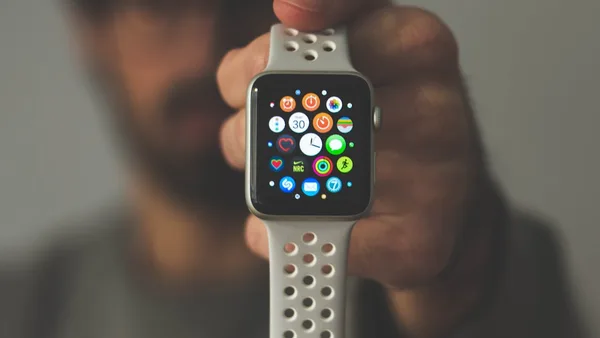
For Apple Watch, 9to5Mac points to the built-in Neural Engine processing features such as gestures, Siri requests, and some health and safety signals on the watch or, in some cases, the iPhone. That matters because the wrist is a constrained device. Battery, heat, latency, and privacy all become design limits.
MLXIO analysis: Apple’s advantage is not just that it has an AI-capable watch. It controls the chip, operating system, phone pairing, health feature layer, and app rules. That gives Apple a cleaner path to turn Edge AI from a spec-sheet feature into something users encounter through gestures, alerts, and health signals.
The Q1 2026 math: 25% penetration, 90% Apple share, 10% for everyone else
Counterpoint says one in four smartwatches shipped in Q1 2026 qualified as Edge AI-capable. That is a meaningful penetration level for a feature class that depends on dedicated silicon and local inference.
But the competitive split is lopsided.
| Q1 2026 smartwatch metric | Reported figure |
|---|---|
| Edge AI-capable smartwatch shipment growth | 70% YoY |
| Edge AI smartwatch market penetration | 25% |
| Apple share of Edge AI smartwatch shipments | ~90% |
| All other vendors combined | ~10% |
The last line is the strategic pressure point. If Apple is near 90%, non-Apple vendors, including Garmin with its Forerunner update, are not fighting over half the category. They are fighting over the leftovers.
Shipment data still needs restraint. Shipments do not prove active usage, feature engagement, or user understanding of on-device AI. A smartwatch can qualify technically even if buyers care more about battery life, design, notifications, or health tracking.
Still, the penetration figure changes the debate. Edge AI is no longer a lab feature. It is present in 25% of smartwatch shipments, and Counterpoint expects penetration to approach 32% in 2026.
Health features are pulling Edge AI onto the wrist
Counterpoint’s health-feature data shows why local AI inference fits smartwatches better than many other device categories. The wrist is always worn, close to biometric signals, and able to respond quickly.
Between Q1 2025 and Q1 2026, smartwatch shipments with key health features rose sharply:
| Health feature | Q1 2025 shipment share | Q1 2026 shipment share |
|---|---|---|
| Blood pressure monitoring | 11% | 23% |
| Sleep apnea detection | 5% | 18% |
| ECG | 31% | 34% |
Counterpoint also said shipments of smartwatches with blood pressure monitoring doubled, while those with sleep apnea detection tripled during the period.
That is the practical case for Edge AI. A watch does not need to send every signal to the cloud if it can process at least some inference locally. The user benefit can be faster responses, less dependence on network conditions, and a stronger privacy argument.
Counterpoint Research Director Mohit Agrawal framed the next phase this way:
“Edge AI in smartwatches is shifting from primarily a hardware integration to one that also includes software optimization. The real unlock is smaller, more efficient models and OS-level access that lets any app run inference locally. AI needs to turn from a single application into a personal layer that works on personal data. This enables instant health alerts, gesture control, and richer personalized experiences, and that is why Edge AI penetration is set to approach 32% in 2026.”
That quote is the key. The transition is from “this watch has a neural chip” to “the operating system lets more software run local inference against personal data.”
Apple’s chip-and-watchOS stack makes the lead harder to copy
Counterpoint’s data does not break down every Apple Watch model or feature by unit count. But the supplied material does identify a clear hardware foundation: Apple introduced the S9 chip in 2023 with a 4-core Neural Engine for machine learning tasks.
That gives Apple a base for on-device features without forcing every interaction through remote servers. On a watch, that is not a minor design preference. It affects responsiveness and battery expectations.
The same logic applies to health data. The more continuous and personal the signal, the more valuable local processing becomes. Heart rate, sleep patterns, temperature, gestures, and safety signals all become more useful when inference can happen near the sensor and near the moment of need.
MLXIO analysis: Apple’s strongest position is the loop between Apple Watch, watchOS, and iPhone. The watch collects signals. The phone adds compute, connectivity, and account context. watchOS controls how apps reach the wrist. That structure can make Edge AI features feel native rather than bolted on.
This is also where developer questions enter. If Apple has nearly all Edge AI smartwatch shipments, watchOS becomes the obvious first target for local-inference wearable apps. But Apple’s platform rules still shape what developers can ship and monetize, a broader tension MLXIO has tracked in Apple Tries to Freeze Epic Games Fight Over App Store. For Apple-adjacent AI tooling beyond the wrist, see Nearly 20 Tools Give Safari MCP Server Its AI Edge.
Rivals face a catch-up problem, but the report gives few clean scorecards
The supplied Counterpoint material does not provide Edge AI shipment shares for Samsung, Garmin, Google, or other individual smartwatch makers. That limits any vendor-by-vendor conclusion.
What it does show is the scale of the gap: Apple at ~90% means the rest of the market combined sits near 10% in Q1 2026 Edge AI smartwatch shipments.
Related Counterpoint-based reporting adds broader smartwatch context. Global smartwatch shipments grew 4% year over year in Q1 2026. Apple held 23% of global smartwatch shipments and posted 21% year-over-year growth. In China, Huawei led the domestic market with roughly 40% share, while Imoo and Xiaomi followed. The China market grew 15% year over year.
That broader data shows Apple does not own the entire smartwatch market. It owns the Edge AI slice to a degree that rivals have not matched.
MLXIO analysis: Non-Apple brands can still compete through battery life, pricing, fitness specialization, regional strength, or phone pairing. But Edge AI raises the bar. It requires capable silicon, local models, OS permissions, sensor quality, and user trust around health data. Missing one layer weakens the whole product.
Counterpoint’s 32% penetration call is the next test
The strongest forward signal is Counterpoint’s expectation that Edge AI penetration is set to approach 32% in 2026. If that happens while Apple remains near 90%, Edge AI smartwatches will look less like an industry-wide transition and more like another Apple-controlled premium layer.
If Apple’s share falls while penetration rises, the story changes. That would suggest other vendors are finally scaling local inference on the wrist. Evidence would include named rivals gaining Edge AI shipment share, more watches with dedicated neural accelerators, and health or interaction features whose primary inference runs locally.
For now, the report points to a concentrated market with fast technical adoption. Edge AI smartwatches are growing. Apple is absorbing most of the growth. The next few quarters will show whether the category opens up — or whether the wrist becomes another place where Apple turns a technology shift into platform control.
The Bottom Line
- Apple Watch is turning Edge AI wearables into a category led overwhelmingly by one company.
- Local AI processing could improve smartwatch privacy, latency, and battery-sensitive features.
- Rivals need stronger on-device AI hardware and features to make the market more competitive.